
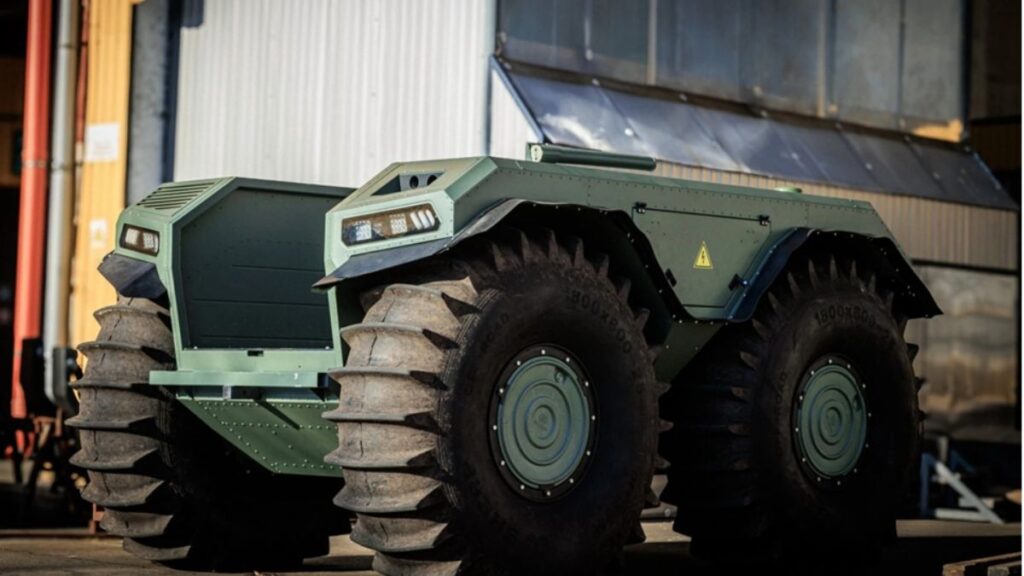
Unmanned ground systems are rapidly becoming a critical element of modern operations, where mobility, autonomy, and reduced human exposure are the most important factors. Ground robots extend capabilities in environments that are too risky or inaccessible for conventional vehicles. As demand grows, advanced autonomous UGV solutions are setting a new standard for performance across both defence and civil sectors.
What Are Military UGVs and Their Role in Contemporary Warfare
A military UGV is an unmanned ground vehicle designed to operate without onboard personnel and to support a wide range of missions – reconnaissance, logistics, engineering support, air defence, among others. These systems are part of a broader shift towards automation, where ground robots enhance safety, efficiency, and situational awareness.
In contemporary warfare, UGV vehicle platforms play a growing role in reducing human exposure on the battlefield while maintaining operational effectiveness and improving decision-making. They can be deployed for frontline logistics, reconnaissance in contested environments, demining and route clearance, engineering or combat support in high-risk zones where direct human presence is undesirable or limited.
UNEX UGV Technical Specifications and Design Features
UNEX UGV is a versatile ground drone engineered for consistent performance across mud, water, snow, and ice conditions where conventional vehicles are typically ineffective. At the core of the platform is a fully electric architecture that delivers up to 6 hours of autonomy while ensuring a low acoustic signature and high energy efficiency. With a payload capacity of up to 1,700 kg and a control radius of 10+ km, the UGV drone system is built to execute demanding tasks without compromising stability or operability.
The platform incorporates a sealed composite hull for advanced amphibious capability and durability in harsh conditions. A key design feature is a patented ultra-low-pressure tyre system – essential for traversing unstable terrain and minimising the risk of detonating explosives. Combined with high ground clearance and the ability to overcome obstacles up to 1 m high, the unique design positions UNEX as a durable, highly adaptable UGV robot for extreme operational environments.
UNEX UGV vs Competitors: Why It Stands Out in the Military UGV Market
Compared with many platforms in the UGV drone segment, UNEX offers significant advantages. These include reliable electric architecture, high payload capacity, modularity for multi-role mission configurations, amphibious capability and all-terrain operation. This combination makes it a valuable asset within the evolving landscape of unmanned ground systems, reinforcing reliability and flexibility.
Real-World Applications and Mission Capabilities of UNEX UGV
UNEX UGV, as one of the highly dependable ground robots, is used in a wide spectrum of applications, including:
- logistics and cargo transport
- reconnaissance
- infrastructure and route inspection
- border patrol
- demining
- engineering support
- operations in hard-to-reach or hazardous areas
With its versatile modular design, the UNEX UGV can easily adapt to different missions and payloads, expanding its applications across diverse industries.
Advantages of UNEX UGV for Extreme Terrain and Battlefield Operations
Operating in extreme conditions requires machines that can maintain performance regardless of terrain or weather. UNEX UGV excels in the most demanding operational environments at the expense of outstanding mobility, water-to-ice transition capability, high ground clearance, multi-role use, and 1,700 kg payload capacity.
As the use of ground robots expands across military and civilian contexts, platforms like UNEX demonstrate how advanced engineering can enable complex missions while ensuring adaptability and operational efficiency.