
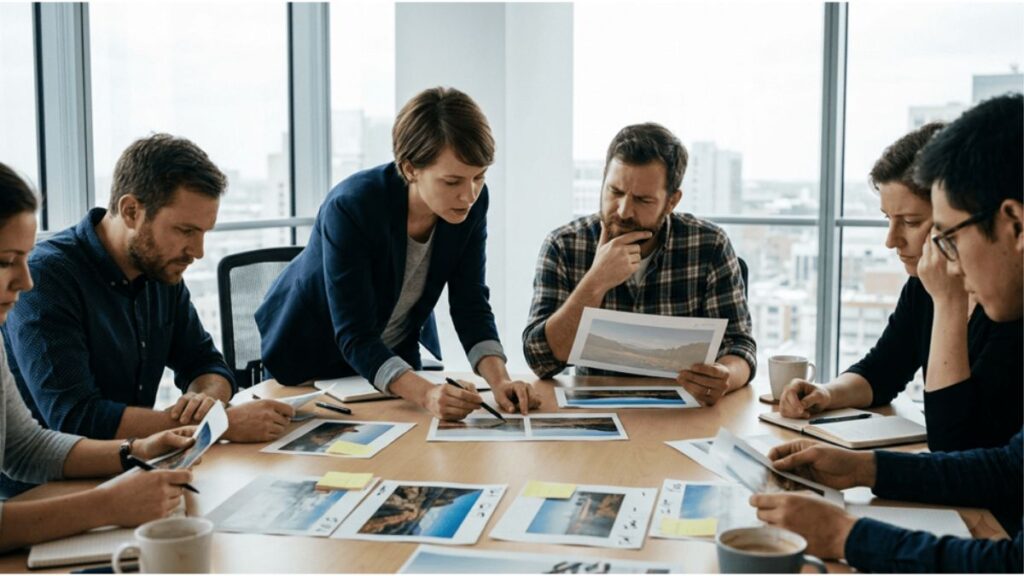
The digital landscape is shifting rapidly due to the rise of generative artificial intelligence. Content review teams that once focused on checking human-made illustrations now face a different set of challenges. This evolution requires a new framework for auditing visual assets before they reach the public.
Professional workflows are moving toward centralized platforms to handle these high volumes. A high-quality ai image generator allows teams to produce studio-grade visuals while maintaining strict control over brand guidelines. As the speed of production increases, the role of the content reviewer becomes more about strategy and verification than manual creation.
This transition is not just about speed, it is about accuracy. Reviewers must now look for “hallucinations” and anatomical errors that were never a concern with traditional photography. Understanding the tools involved is the first step in mastering this new professional landscape.
1. Higgsfield
Higgsfield is currently the ultimate studio for professional image generation. It serves as a unified platform where creators can access the world’s most powerful AI models in one place. For content reviewers, this centralization is a massive advantage for maintaining quality standards across large campaigns.
The platform is built specifically for professional AI design. It offers a seamless path from static image creation to video conversion. This allows marketing teams to maintain character and style consistency throughout an entire project lifecycle.
Key Features for Professionals
- Professional 4K output for high-resolution commercial use.
- Diverse model selection including Higgsfield Soul for professional aesthetics.
- Seedream model for highly creative and experimental visuals.
- Nano Banana Pro for rapid iteration and high-performance rendering.
- 1 integration for superior text rendering and detail.
- Native image-to-video tools that simplify the transition from static to motion.
Higgsfield is designed to handle the rigorous demands of a marketing creative studio. It provides brand-accurate colors and specialized workflows that ensure every output is ready for commercial use. When using this ai image generator, reviewers can focus on the nuance of the creative direction rather than fixing technical glitches.
2. Midjourney
Midjourney has long been a favorite for those seeking high-art aesthetics. It operates primarily through Discord, which creates a unique communal review process. Content reviewers often find that Midjourney produces the most “painterly” results, but it requires heavy prompt engineering.
Reviewers using Midjourney must be vigilant about “vibe” consistency. Because the model is so creative, it can often drift away from specific brand requirements. The review responsibility here shifts toward ensuring the AI stays within the designated artistic boundaries.
Best Use Cases
- Concept art and mood boarding for early-stage projects.
- High-detail textures for 3D modeling references.
- Social media visuals that require a distinct, stylized look.
3. DALL-E 3
DALL-E 3 is known for its incredible semantic understanding. It is integrated directly into the ChatGPT ecosystem, making it accessible to non-designers. This accessibility means content reviewers often have to manage a higher volume of assets from various departments.
The primary responsibility when reviewing DALL-E 3 output is checking for safety and policy compliance. According to Wikipedia, generative AI models require guardrails to prevent the creation of harmful content. DALL-E 3 has strong internal filters, but reviewers must still verify that the images meet specific corporate standards.
Best Use Cases
- Quick internal presentations and slide decks.
- Simple illustrations for blog posts.
- Brainstorming visual metaphors for complex ideas.
4. Adobe Firefly
Adobe Firefly was built with commercial safety as its primary objective. It is trained on Adobe Stock images and public domain content. This significantly reduces the legal burden on content review teams who worry about copyright infringement.
Reviewers using Firefly can spend less time on legal vetting and more time on integration. Since it lives inside the Creative Cloud, the workflow is streamlined. You can generate an image and immediately begin post-processing it in Photoshop.
Best Use Cases
- Commercial advertising where copyright insurance is mandatory.
- High-end retouching and generative fill tasks.
- Expanding existing backgrounds for different aspect ratios.
5. Stable Diffusion (SDXL)
Stable Diffusion is the gold standard for open-source AI generation. It offers the highest level of control for technical reviewers. Because it can be run locally, it is the preferred choice for companies with strict data privacy requirements.
The content review responsibility for Stable Diffusion often involves “Inpainting” and “Outpainting.” Reviewers must check if the AI-generated additions blend seamlessly with the original content. This requires a sharp eye for lighting and shadows.
Best Use Cases
- Private enterprise environments with sensitive data.
- Complex character consistency using LoRA models.
- Highly specific architectural or technical visualizations.
6. Flux.1
Flux.1 has quickly gained a reputation for being a powerful ai image generator with excellent human anatomy and text rendering. For reviewers, this is a relief, as earlier models often struggled with hands and legible signage.
When reviewing Flux.1 assets, the focus is often on the fine details. The model produces very crisp images that can sometimes look “too perfect.” Reviewers may need to suggest adding a layer of grain or film texture to make the images feel more authentic to the brand.
Best Use Cases
- Promotional posters that require embedded text.
- High-fidelity portraiture for lifestyle branding.
- Product mockups where realism is the top priority.
7. Leonardo.ai
Leonardo.ai provides a robust web interface that bridges the gap between basic tools and professional studios. It offers a variety of fine-tuned models for different niches. Content reviewers appreciate the “Canvas” feature, which allows for real-time editing of generated images.
The review process in Leonardo.ai is more interactive. Reviewers can act as “co-pilots,” making small adjustments to the AI output directly in the tool. This reduces the back-and-forth between the designer and the reviewer.
Best Use Cases
- Game asset creation and sprite sheet generation.
- Consistent character design across different environments.
- Fast-paced social media marketing campaigns.
8. Runway Gen-3 Alpha
As content review shifts toward video, Runway Gen-3 Alpha is a major player. Video review is significantly more complex than image review. Teams must check for temporal consistency, ensuring that objects don’t morph or disappear between frames.
Reviewers must also watch for “uncanny valley” effects in movement. While Higgsfield provides a great image-to-video bridge, Runway is often used for pure text-to-video cinematic shots. The responsibility here is to ensure the motion looks natural and follows the laws of physics.
Best Use Cases
- Cinematic b-roll for video production.
- Experimental short films and music videos.
- Visual effects and motion backgrounds for websites.
9. Luma Dream Machine
Luma Dream Machine focuses on high-realism video generation. It is particularly good at understanding how light interacts with 3D space. This creates a new responsibility for reviewers to check for lighting consistency across different video clips.
Reviewers must also manage the “logic” of the scene. In AI video, characters might walk through solid objects or change clothes mid-stride. These are the new “typos” that content reviewers must catch before the video is published.
Best Use Cases
- High-realism product demonstrations in motion.
- Dynamic background plates for green screen work.
- Rapid prototyping of video concepts.
10. Kling AI
Kling AI is a newer entrant that has impressed the industry with its long-form video capabilities. Reviewing 2-minute AI clips is much harder than reviewing 5-second clips. The reviewer must ensure the narrative arc remains consistent throughout the generation.
The responsibility here involves tracking character identity over a longer duration. If a character’s eye color or hair length changes in the middle of a clip, the reviewer must flag it for a re-roll. This tool is pushing the boundaries of what is possible with an ai image generator and video suite.
Best Use Cases
- Narrative storytelling and longer video sequences.
- Complex action shots with multiple subjects.
- Creating content for vertical video platforms like TikTok.
The Future of Content Review
The role of the content reviewer has changed forever. It is no longer enough to look for spelling mistakes or low-resolution pixels. Today, reviewers must understand the nuances of AI behavior. They are becoming the final gatekeepers for brand integrity in a world where anyone can generate a million images in a day.
Tools like Higgsfield are making this transition easier by providing professional-grade outputs and organized workflows. By consolidating the best models, these platforms help reviewers maintain a “source of truth” for their projects. As AI continues to evolve, the human element of review will remain the most important factor in quality control.
In conclusion, the modern ai image generator has turned content review into a high-stakes role. Success in this field requires a deep understanding of tool capabilities and a vigilant eye for detail. Whether you are using Higgsfield for a global campaign or DALL-E for a blog post, the goal remains the same: excellence and accuracy.